Your Blood Sugar Number Keeps Climbing — And It Was Never Because You Weren't Trying Hard Enough
If you cut the carbs, took the pills exactly on schedule, walked every morning, and your numbers still crept up — the problem was never your discipline. It's happening one layer deeper than the food on your plate.
Let Me Guess What the Last Few Years Have Looked Like
You got the diagnosis. Or the "pre-diabetic" warning that was supposed to be a wake-up call.
So you did what they told you.
You cut the bread. Then the fruit. Then the potatoes, the rice, the one glass of orange juice you actually looked forward to. You started reading labels in the grocery store like they were legal documents.
You took the metformin. On schedule. Even the weeks it wrecked your stomach and you planned your errands around where the bathrooms were.
You walked. You lost some weight. Maybe a lot of weight.
And then you went back for bloodwork — and the number had barely moved. Or it had gone up.
So the dose went up.
Then a second medication got added.
And somewhere in that appointment, someone said the sentence you've been dreading: "If this keeps trending like this, we may need to start talking about insulin."
Here's what I need you to hear before you read one more paragraph:
That was not a discipline failure. You were following instructions that were aimed at the wrong layer of the problem.
Important: nothing in this article is a reason to stop, skip, or reduce any medication you've been prescribed. Everything below is about what happens alongside the care you're already getting — not instead of it. Any change to your treatment is a conversation with your doctor, not with a webpage.
The Number on the Meter Isn't the Problem. It's the Receipt.
Almost everything you've been told about managing blood sugar is about how much glucose goes in.
Count the carbs. Watch the glycemic index. Smaller portions. Skip dessert.
That framing has one enormous blind spot. It treats your body like a bucket — as if the only thing that matters is how much you pour in.
But your blood sugar reading isn't really measuring what you ate. It's measuring how much glucose is still sitting in your bloodstream instead of being let into your cells.
Those are two completely different problems. And only one of them is fixed by eating less.
Insulin Is the Key. Your Cells Have the Lock. That's Where This Actually Goes Wrong.
Here's the mechanism in plain language.
Glucose is fuel. Your muscles, your brain, your organs all run on it. But glucose can't just wander into a cell on its own — the cell has to open the door.
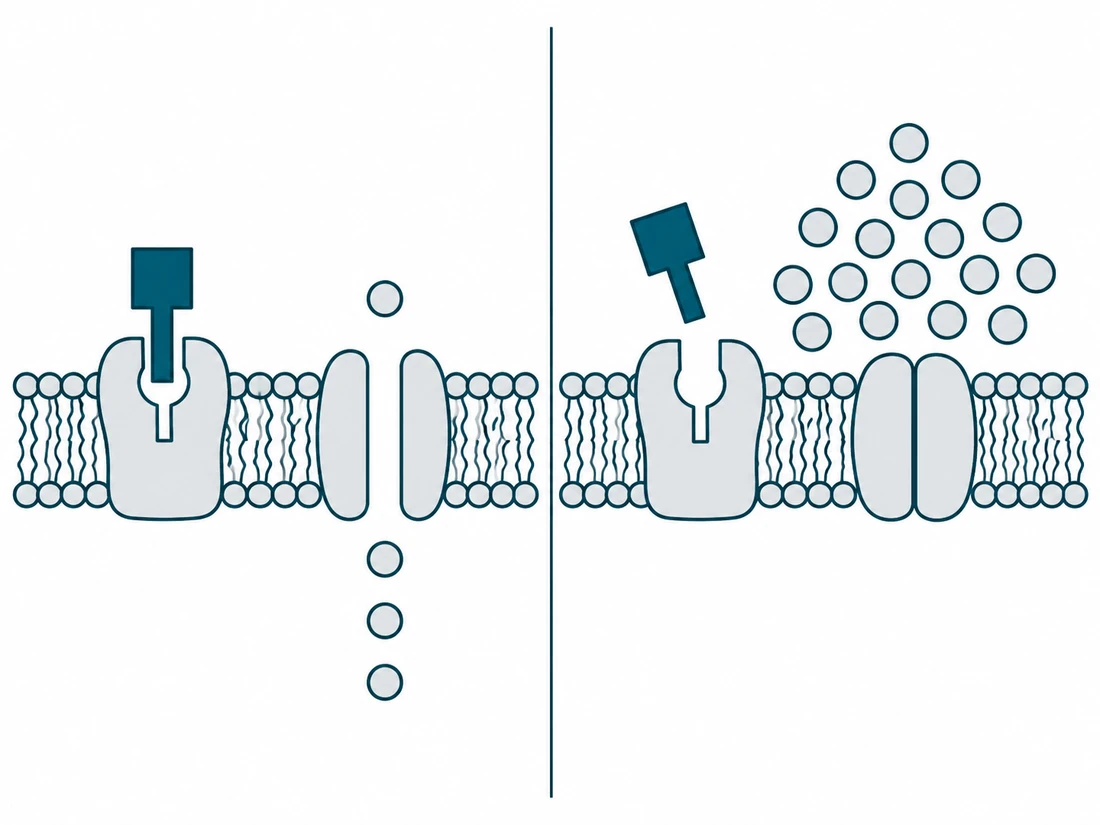
Insulin is the key that opens it. Your pancreas releases insulin, the insulin docks onto a receptor on the outside of the cell, and the cell opens up and pulls the glucose in.
Insulin resistance is what happens when that lock stops responding properly to the key.
The pancreas is still making insulin. The insulin is still showing up. But the cell isn't answering the door the way it should.
So the glucose stays in the blood. Your meter reads high.
And your pancreas — which has no idea the lock is the problem — does the only thing it knows how to do:
It makes more insulin. It hammers on the door harder.
This is the part nobody explains at the 12-minute appointment, and it's the part that makes everything else make sense.
It explains why the diet stopped working. You can eat less and less, but if the doors aren't opening, you're still going to have glucose stacking up in your blood — you're just miserable while it happens.
It explains why the dose kept climbing. Medications that push more insulin, or push your kidneys to dump more sugar, are working on the amount in circulation. Some of them help enormously — that's why you keep taking them. But if cell response is drifting in the wrong direction underneath, the amount of help needed tends to grow over time.
And it explains the exhaustion. The tiredness after meals. That heavy, foggy stretch in the afternoon where you could fall asleep sitting up. That's not laziness and it's not just age — your cells are surrounded by fuel they're struggling to bring in.
This is established physiology, not a theory. Insulin resistance is the mechanism at the center of how type 2 diabetes develops and progresses. It's in the standard clinical literature. It is not a hidden secret and nobody is suppressing it. The real gap is that almost nothing in the average person's routine is aimed at it directly.
There Are Four Things People Try. Three of Them Don't Touch the Lock.
Once you understand that the door is the problem, you can sort every approach you've ever tried into one of four buckets — and immediately see why three of them left you where you started.
Approach #1
Cutting More Carbs
Reducing refined carbohydrate does matter — it lowers the load arriving at the door. If you've had success with it, keep going.
But restriction manages input. It doesn't change how your cells respond to insulin. That's why so many people describe hitting a wall: the first stretch produces real movement, and then the numbers settle onto a plateau that no further sacrifice seems to break.
You can't starve your way into a cell opening its door.
Approach #2
Single-Ingredient Supplements
Berberine. Chromium. Cinnamon. Alpha-lipoic acid. Bitter melon.
You've probably got at least two of these in a cabinet right now, half-finished.
Some of these ingredients have genuinely interesting research behind them. The problem usually isn't the ingredient — it's everything around it. A capsule you remember four days out of seven. A dose set by whatever the manufacturer could fit in the bottle at the price point. A formula built to be cheap to produce rather than built around how the compound actually needs to be delivered.
An ingredient that never reaches a meaningful, consistent level in your system is an ingredient that was never really tested in your body.
Approach #3
Prescription Medication
This one needs to be said carefully, because there is a lot of irresponsible content on the internet about it.
Your medication is doing real work. Keep taking it exactly as prescribed. For many people it's the single most important thing standing between them and serious complications. Nothing on this page is a substitute for it, and anyone who tells you to stop taking it is putting you in danger.
What's fair to say is this: most of these medications are designed to manage circulating glucose — by increasing insulin, improving how the liver behaves, or clearing sugar through the kidneys. They are excellent at what they were designed for.
What most of them were not designed to do is take pressure off the underlying cell-response problem. That's why "well-controlled" and "improving" aren't the same word, and why the treadmill of escalating doses feels the way it does.
Approach #4
Supporting Insulin Sensitivity Directly — Every Single Day
This is the only one of the four aimed at the lock instead of the load.
The goal isn't to force glucose out of your blood. It's to support the cell's ability to respond to the insulin your body is already producing — so the fuel goes where it's supposed to go.
And the two things that decide whether that support works at all are the least glamorous words in this entire article:
Consistency and delivery.
Why the Delivery Format Turned Out to Matter More Than Anyone Expected
Here's an uncomfortable truth about the supplement aisle.
The most common reason a supplement "doesn't work" isn't that the ingredient was worthless. It's that the person stopped taking it — or took it inconsistently enough that it never mattered.
If you're already managing multiple prescriptions, a capsule that has to be taken at a specific time, on a specific stomach, is one more thing to forget. And if it's an ingredient that's known for irritating the digestive system, you've got a second reason to quietly abandon it around week three.
That's the problem the patch format was built around.

A patch is worn, not swallowed. You apply it, you go about your day, and there is no capsule to remember, no water to find, and nothing hitting an already-sensitive stomach.
For a lot of people, that's the entire difference between a bottle that gets abandoned and a routine that actually gets followed long enough to evaluate.
What GLPro Patch Is — and What It Isn't
GLPro Patch is a dietary supplement in transdermal patch form, formulated to support healthy glucose metabolism and healthy insulin sensitivity as part of a normal daily routine.
Let's be precise about what that sentence means, because precision is exactly what's missing from most of what you'll read in this category.
- It is a supplement. Not a drug, not a treatment, not a replacement for anything your doctor has prescribed.
- It supports healthy blood sugar levels already within the normal range. It does not treat, cure, reverse, or prevent diabetes — and any product claiming otherwise is telling you something no supplement is legally or scientifically permitted to claim.
- It is designed around adherence. One patch, applied daily. That's the routine. The format exists because the best formula in the world does nothing sitting unopened in a drawer.
- It works alongside your existing care. You keep your prescriptions. You keep your appointments. You keep testing.

If You're Still Reading, This Was Written for You
Not everyone who lands on this page is the right person for it.
If your numbers are stable, your doctor is happy, and nothing has changed in years — you probably don't need what comes next.
But if you recognized yourself in the first section — the escalating dose, the diet that stopped producing results, the appointment where insulin came up — then there's a longer explanation you should see.
It covers the specific formulation, what's actually in it, how the delivery format was designed, current pricing and guarantee terms, and the honest limitations of what a supplement can and cannot do.
It's a video. It's free. And it's the same presentation whether you buy anything or not.
Free to watch · No email required · Takes about 12 minutes